(From my all-time favourite little book, Letters to a Young Poet, letter 6)
Rome
December 23, 1903
My dear Mr. Kappus,
I don't want you to be without a greeting from me when Christmas comes and when you, in the midst of the holiday, are bearing your solitude more heavily than usual...
Why don't you think of him as the one who is coming, who has been approaching from all eternity, the one who will someday arrive, the ultimate fruit of a tree whose leaves we are? What keeps you from projecting his birth into the ages that are coming into existence, and living your life as a painful and lovely day in the history of a great pregnancy? Don't you see how everything that happens is again and again a beginning, and couldn't it be His beginning, since, in itself, starting is always so beautiful?
...Is there anything that can deprive you of the hope that in this way you will someday exist in Him, who is the farthest, the outermost limit?
Dear Mr. Kappus, celebrate Christmas in this devout feeling, that perhaps He needs this very anguish of yours in order to being; these very days of your transition are perhaps the time when everything in you is working at Him, as you once worked at Him in your childhood, breathlessly. Be patient and without bitterness, and realize that the least we can do is to make coming into existence no more difficult for Him than the earth does for spring when it wants to come.
And be glad and confident.
Yours,
Rainer Maria Rilke
Friday, July 13
A Great Pregnancy; or, Christmas in July

Tuesday, May 15
Ajuda Me

A few nights ago I dreamt that I was back at a cafe in Portugal, ordering pastries and coffee in the early evening. It was the first dream I've had in a long while where I was speaking Portuguese, not English. After ordering my milky galao, the sassy-pants barista demanded that I order an aperitif instead of a coffee, on account of the hour of the day. I can't imagine this ever happening in Portugal. It was as if I were in Italy (where I can imagine this happening) and was reprimanded for ordering a cappuccino too late in the day. Flustered, I did my best to apologize for my huge social blunder.
But then, the nightmare. I couldn't remember how to say "I'm sorry" in Portuguese. All I could get out of my mouth was "mi dispiache," which is the Italian.
To make matters more weird, numerous days later (in real life), I still can't remember what the Portuguese is for "I'm sorry." I lived there for over 3 years, and all I can think of is the Italian! Granted, the last thing I did before I moved from Portugal back to America was to take a 2-week intermediate Italian class in Florence. But still. I'm troubled. Somebody ajuda me.
(Photo of the lovely Costa da Caparica: Dsevilla)
Tuesday, March 20
What I've Been Working On
If you would like to know what I've been working on, here is one thing. I recently finished a project for my class on Ministering to Street Children, and I got the wild idea to submit it as a blog-article, rather than just a boring paper (with an extra-large title...) "Listening to the Marginalized Voices of the Church to Awaken Faith: A Proposal for a Ministry of Love and Power to Street Children in Italy."
It features Heidi and Rolland Baker, yelling-at-Satan-Carlos Annacondia, Bill Johnson, the infamous John Wimber, Chuck Kraft, and my ideas for a new ministry in Naples, Italy. I hope it'll be a work-in-progress. Feel free to skim your favorite sections, and leave any comments if you desire to disagree, or to shout a sweaty, "amen." (I think my professora in Costa Rica would get a kick out of the conversation.)
Wednesday, March 7
Most Vivid Dreams - Part 3

Last night I had another incredibly vivid dream. I'm sure part of it was born out of one of my classes at Fuller: Ministering to Street Children.
I was in Italy, sitting on the second floor of an apartment that faced the street. It was a gloomy, rainy day, and I was looking out the window. My eye caught two young girls who'd walked out into the street who couldn't have been older than seven. They were all alone and playing in the puddle-filled street.
Then, in the magical-speed of dreams, the street below began flooding with rain, and water rushed from one end to another. The little girls seemed totally unaware of the danger that they were in. One of them had a toy boat that was large enough for her to sit on, and from the window I saw her motioning as if she was going to try to ride on it for fun in the flooded street.
I looked around the apartment and realized that no one but me saw this happen. So I barreled down to the street, only to arrive to find her being carried away by the stream. I felt helpless. But then as I peered way down the street I could see a small group of adults who were headed towards her to catch her.
I ran over to the girls' friend, who was still street-side, totally unaware of what had just happened. She had a "nobody can hurt me" attitude about her, though she was so very young. She was incredulously drinking cheap beer, even. I tried asking her in (my pitiful) Italian if she thought her friend was ok, but she answered me in English, quite nonchalantly. It didn't seem she even cared.
The group of adults showed up with the girl, and they appeared to be folks about my age. There were four of them, mostly from the States, but one from Asia. They explained that they all ended up in Italy through this one friend of theirs' named, Chuck. So, strangely, instead of giving me their contact info, they gave me his.
And we all ended up at a weird American breakfast buffet that was very strange to find in Italy. Other Americans joined us, but they seemed clueless on how to be polite and quiet in a European country. No one knew how to pay the bill properly, so I ended up doing it.
(Flood Picture from the National Weather Service's article on Flash Floods: Turn Around Don't Drown.)
Monday, December 25
Even Today We Need Him
Pope Benedict XVI's Christmas Day address is quite beautiful and resounding. Here it is translated from the Italian: Pope's 'Urbi et Orbi'.
...How can we not hear, from the very depths of this humanity, at once joyful and anguished, a heart-rending cry for help? ...Today "our Saviour is born to the world", for he knows that even today we need him.
...Who will make this message of hope resound, in a credible way, in every corner of the earth? Who will work to ensure the recognition, protection and promotion of the integral good of the human person as the condition for peace, respecting each man and every woman and their proper dignity?
...May the Divine Child, the Prince of Peace, grant an end to the outbreaks of tension that make uncertain the future of other parts of the world, in Europe and in Latin America.
and all God's people said, "oh yes!"
Monday, December 11
Most Vivid Dreams - Part 1

I've been having the most extensive, vivid dreams. Last night my dream was replete with Europe, my murderous spirit, show-tunes, The Last Supper, and the Postal Service. (Enjoy the trip in to my psyche. Any interpretations welcome.)
In my dream last night I was with some of my roommates from Portugal, a couple youth group kids from here in La Plata, USA, and a few other friends. We were headed on a road trip to get somewhere in Europe. I’m not sure if we'd started in Europe or in America.
On the way, we stopped to see my great uncle, because it was a good resting point on the way. In the dream uncle was an invalid, and was being taken care of by the daughter of one of his closest friends, who lived on the second floor. Uncle couldn’t talk, but he could snore really good. The lady upstairs would often yell down from her bed to hush his loud snores.
It was time for all of the road-trippers to go to bed. We were all sort of camping out in the living room, stuffed like sardines. As we were falling asleep, I was about to close my eyes, and I saw that a girl and guy were crammed on the couch sort of snuggling to sleep. I immediately remembered a prior conversation I’d had with the girl in which she bemoaned how snuggling-boy had been giving her so many confusing mixed signals about their relationship. (The majority of which signals were, “I don’t like you.”)
So, in all of my Jenelle-confontationalism, I said to snuggling-boy from my sleeping bag, “You are such an idiot. You’re just an idiot. Sometime before we leave tomorrow, I'm going to tell you why.”
Now quite annoyed, and unable to sleep, I traveled upstairs. I found a shy Dutch girl, but we couldn’t understand each other enough to speak. She was voraciously reading some novel in Dutch. Another lady from the Netherlands was there, too, and she was crazily multi-lingual. She grabbed a gigantic English/Ancient Greek dictionary, and started translating words from Ancient Greek to English to Dutch for me. Nice lady, she was.
Then Scott and Terri Last (once in Florence, now on their way to work with CAI in my Portugal) wandered in. Terri told me how she’d just spent a week at IHOP, and I flipped out telling her how I’d met with God at IHOP back in September. I was glad they were starting to settle into their new home in Portugal.
I came back downstairs to find that everyone was now awake. Apparently my you-are-an-idiot words to the boy had caused a lot of commotion. (I sort of liked that.)
To the boy I returned and (somewhat) elaborated, “You are either an idiot or just a fool. I think you’re just a foolish idiot.”
The best part was how I then recalled how Jesus said that calling someone a "fool" or "idiot" is the same as us acting in a murderous spirit. And that sobered me. (But I was too irritated to apologize to him.)
And with that, we all took off for our European adventure. We started on a riverboat cruise, in Istanbul or something, and we saw the most amazing sunset with ancient ships strewn against the horizon. I dug for my camera and tried to capture the scene. I failed. The pictures only showed a tenth of the actual view.
We wandered into a hostel and spoke to the man at the reception. There were multiple magazines in all sorts of languages on the shelf behind him. The man was Italian and spoke broken English. When I caught his eye, he grabbed one of the English magazines, came out from behind the counter and started singing a homemade show-tune! He sang acapella, and it was all about how he was going to learn English. (I was amazed at how well he stayed in tune! It was a great song, I wish I could replicate it here.)
He danced as he sang wide-eyed about how all his dreams would soon come true.
As he sang, I saw a live-music video of sorts. There was a catwalk, and a stage, and a curtain that opened. He sang about all of the places in Europe that he'd soon visit, and how his pilgrimmage would help him in his “spiritual journey." As he sang about each city's artwork, the curtain would then open and a life-sized image would float down the catwalk towards me. There were five images, and they were all various famous artistic pieces associated with Christ and the cross. The last one was “The Last Supper.” As that image came towards me, I walked into it.
All of a sudden I entered three different (somewhat hilarious) contemporary versions of the da Vinci's Last Supper. It was like I was on the front of the stage, watching as the actors rehearsed. The one I remember most had all of the disciples dressed as American fraternity boys from the 1950’s, with brightly-colored shirts and slick hair. Some had bow-ties, too. I'm pretty sure Jesus still had his white robe on, though.
When Jesus exited by stage-right, he jumped down into a super-sonic-speed ancient carriage. It was all so fast and dangerous, and I was worried that he got hurt in the jump. But then Tara (who is Young Life Europe’s Regional Administrator…Tara does everything and knows everything), quickly appeared and told me the physics of how these carriages work. And then I calmed down. Jesus would be just fine.
So I jumped into the ancient (but super-sonic-speed) carriage and ended up in Cascais, Portugal. Only it wasn’t just Cascais, but a hybrid of both glitzy Paris and flavorful Italy. I realized that I needed a break to be alone, so I started looking for a cafe to escape in. I rehearsed in my head how I’d ask the barista, “Un cappuccino, per favore” with the proper Italian accent.
But on the way to the cafe, I saw this guy, R.J. in the crowd (who stuck out only because he was about one foot taller than all of the short Southern Europeans.) (R.J. was my best friend from high school's boyfriend in the 10th grade. I haven’t seen him in 10 years.) I was so excited to see another La Platian’s face in Europe that I gave him a gigantic hug. (And proceeded to re-introduce myself to him, in case he didn’t remember me.) R.J. had on a snappy Postal Service uniform, and explained to me that he’d been working for the U.S. Postal Service in Paris, and had just gotten transferred to Cascais.
“Oh!" I said. "You’ll just love it here. I lived here for almost four years. I promise, you’ll love it. It's so beautiful and right here in Portugal.”
And then I remembered how (in real life) the day that I interviewed with the U.S. Postal Service, they told me that once I finished my Masters, I should consider working for the International division…to get a job back in Europe dealing with mail. (The End.) Image from Wikipedia
Thursday, November 23
Grazie, Tino; 107
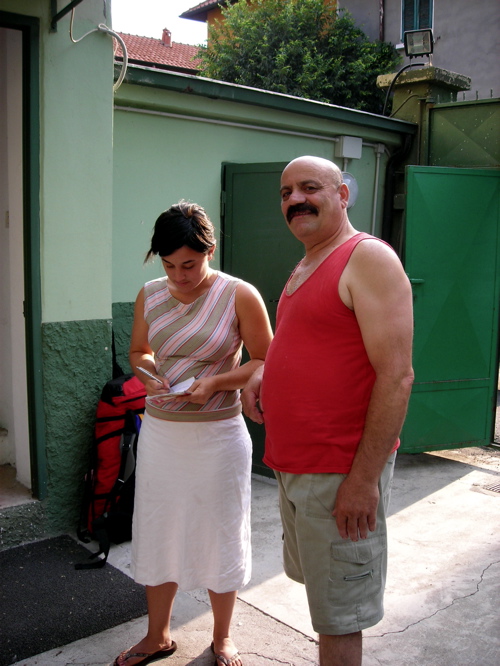
The sun is setting on another American Thanksgiving. The infamous "Black Friday" is approaching. (For all of our dear non-American friends, tomorrow is the day in the States when hoards of shopper-bugs descend on shopping malls and stores to get the most tasty Christmas sales. Some even camp out on the streets in the bitter cold to be the first in the door at 6am. Insane consumerism, at our best.) Tonight, my mind is in Italy. I'm remembering Tino from Milan. And I can't stop reading Psalm one oh seven. The one with this four-pronged refrain:
Oh, that men would give thanks to the Lord for His goodness, And for His wonderful works to the children of men! (NKJV)
This summer I did a three-week mission in Italy with a team from 24-7 Prayer. We prayed through the cities, met with different churches, and helped set up some 24-7 prayer rooms. We met Tino on our first stop in Milan. He worked at the church and lived a beautifully simple life.
What I remember about Tino is that he called me "Gina." (A rough Italian equivalent of "Jenelle"?). And I remember that he rode his bike 20 km both to and from work everyday, because he didn't have a car. I remember how his mobile phone would ring non-stop during dinner, and how he'd refuse to answer it. In Tino's Italy, meals are sacred.
Most of all I remember how Tino always bowed his head to humbly say a "thank you" prayer both before and after our meal. I wish I caught every word of his Italian, but for the most part I got it. He was pausing to tell God thanks for being God. (And at the end of his meal, no less! Who does that?)
When I read Psalm 107, I hear Tino waving his work-worn hands at me, urging me as a Psalmist: "Oh, that you would give thanks to the Lord for his goodness, and his wonderful works towards you..."
Tuesday, October 24
Names Written on Water
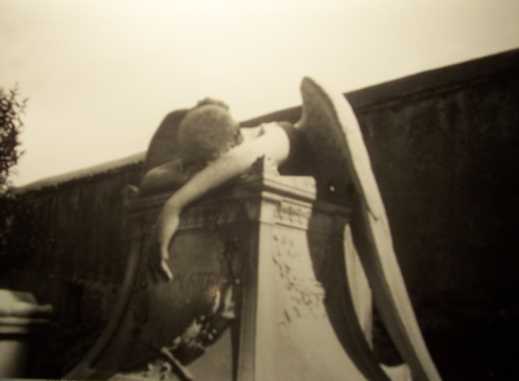
In 1999 I spent a semester studying in Rome. Just outside the old Roman walls, there is a Protestant cemetary where a great many famous Englishmen are buried. I wandered into that cemetary one perfectly overcast afternoon and spent time talking with God about life. I needed a break from the hustle of emotions that is Rome. Quite suprisingly, that cemetary was one of the most peaceful places I've ever wandered. The tombstones were works of majestic art. While I was there, I spent a lot of time lingering near John Keats' grave.
Keats was 25 when he died of tubercolisis in 1821. He was a brilliant English poet and a hinging force of the Romantic Age. He was the one who wrote that famous line, "'Beauty is truth, truth beauty,' - that is all Ye know on earth, and all ye need to know".
But what fascinates me most about Keats was that he refused to have his name written on his tombstone. Instead, he insisted they write, "Here lies one whose name was writ in water."
A week ago a young man died in my town. He was my age, only 26. I didn't know him well, but my Mom did. I had actually spoken with him just hours before he died. He fell asleep that night and never woke up. I went to his wake and cried my eyes out. And in the funeral parlor I couldn't stop staring at a (not terribly artistic, but still profound) painting of Jesus escaping alive from his stony casket.
Today I found out that a young woman whom I'd once known very well committed suicide. Many years have passed since we'd seen each other, but her honest, prayerful questions are still fresh in my mind. They were excellent questions about God's sovereignty in the midst of searing pain. We wrestled with them together, but we didn't necessarily emerge with any cheap or quick answers. Her (almost awful) honesty found its way in my poetry notebooks and scribblings, as I reflected on some of our conversations. Finding them, I wonder if she knew that she could have been a Psalmist.
In the same sitting today, I found a lengthy obituary for Sister Teresa Feeley, who died at 74. Sister Teresa was the younger sister of Sister Kathleen Feeley, who had been a visiting professor my freshman year at UMBC when I took her expository writing class. In my rush of grief, I got the two sisters confused, and thought I was in the twilight zone of death. Memories of Sister Kathleen are appropriate here. She was one who taught me about old John Keats. I really got a kick out of her sharing stories from her sweet Catholic life, though they echoed in our blaringly secular classroom. As an English professor she was delicate and kind, but yet unyielding. She'd look us each in the eye as she'd slowly quote Wordsworth, standing there in her white habit, poised and grasping the lectern: "Poetry is emotion recollected in tranquility."
Our names are written on the water. All of our days are like grass, here today, and gone tomorrow. You could say that I've been considering Moses' Psalm 90 a lot lately.