Showing posts with label poetry. Show all posts

Wednesday, November 21

Mercy is Entirely the Subject


I ducked into my favorite local coffee shop early this morning and ordered an Americano in a warm mug. Sitting down, I felt slightly naked because I didn't have a book with me. I always carry something. (I think it's like policemen who carry guns.) At least I had my little moleskine journal.

Knowing that I needed to defrag from the flurry of papers I'm writing for classes, I thumbed through used books from the shop's corner shelves, and found a tattered gem: Writers at Work: The Paris Review Interviews. Interviews with poets like Ezra Pound, T.S. Eliot, and Marianne Moore, and they're talking about the process of writing! (In 1963 it cost $1.65.) It's true. I get high on old books.

Robert Frost is interviewed first. His glib tone translates perfectly from those old tape recordings down onto the pages. I scribbled a handful of his words on the creative process, and a few concerning a certain ancient book:

"I noticed that the first time in the world's history when mercy is entirely the subject is in Jonah...Jonah is told to go and prophesy against the city and he knows God will let him down. He can't trust God to be unmerciful. You can trust God to be anything but unmerciful. So he ran away and--and got into a whale. That's the point of that and nobody notices it. They miss it." -Robert Frost

I like that Jesus even hides in the theology of old poets. In his pre-whale days, Jonah would only go to Ninevah if he could trust God to be unmerciful towards them. Since he (obviously) couldn't do that, Jonah runs, presumably pouting, "and got into a whale." Mercy is entirely the subject.

I am awfully good at pouting, I'm afraid. Isn't it strange how we humans want mercy for ourselves, but not for the ones we'd rather not forgive?

(Read the whole Frost interview here.)

(Mercy photo by Summers)

Saturday, November 3

Haiku, For Joy


Joy strains to find her
Late at night there is stirring-
November arrives.

Very impressive where's waldo-ing, particularly as I have not yet met Joy face-to-face. Yes, I have met joy, and we shake hands and then play dodgeball. (Or, we play dodgeball and then shake hands?) But I have not yet met Joy.

"One for sorrow, two for joy." -The Innocence Mission

(Haiku hacker image by Elijah)

Saturday, September 29

Am I A Falcon, A Storm?


Two bags packed, one to go.

Last night I had three teenage girls in my living room to help me "sort my clothes." To allow a sixteen-year old the right to advise you on what you ought pack in your suitcase is both enlightening and frightening. To have three of them is to invite a war, of sorts. There was much laughter. At one point, I had to ardently defend the rights of my favorite soft green shirt.

Girls: "That's for the give-away pile, Nelly. It spells, 'Grandma.'"

Me: "But!"

Girls: "Oh, Nelly, please. No Grandma shirts."

Me: "Listen you! I do not look like a Grandma in this shirt! I'll prove it to you." [Theatrically grabs a black skirt with the green shirt and huffs away to the dressing room.]

I won. The shirt lives. But a lot of other stuff dies to the give-away pile.

Operation Pack is spelled: simplify, give-away, simplify. The nice thing about two transcontinental moves in five years is that you learn to condense your belongings into a few suitcases. It feels good.

Before I fell asleep I read a nice poem by Rainer Maria Rilke (in translation). I found myself in it. From his Book of a Monastic Life:

I live my life in widening circles
that reach out across the world.
I may not complete this last one
but I give myself to it.

I circle around God, around the primordial tower.
I've been circling for thousands of years
and I still don't know: am I a falcon,
a storm, or a great song?

Wednesday, July 11

Go to the Limits of Your Longing

I came across this old poem from long ago, the one that my mentor in college ripped from her Rilke's Book of Hours, and mailed to me in a letter. I tacked it to every bedroom wall I lived within for many years. Now I'm unsure of where that tattered page could be. Yet, words are recovered. If ever there was a reason to learn German, it is to be able to read Rilke in his original voice:

God speaks to each of us as he makes us,
then walks with us silently out of the night.

These are the words we dimly hear:

You, sent out beyond your recall,
go to the limits of your longing.

Embody me.

Flare up like flame
and make big shadows I can move in.

Let everything happen to you: beauty and terror.
Just keep going. No feeling is final.
Don't let yourself lose me.

Nearby is the country they call life.
You will know it by its seriousness.

Give me your hand.

- Rainer Maria Rilke

Thursday, October 26

Names Written on Water - Part 2


[I promise to turn the topic to something less heavy soon.]

I wept from my belly a lot today as I spent many hours at a viewing
of an old friend. I dug up a simple poem that I wrote in 2000,
because it paints a similar scene to my today:

At the Viewing of a High School Senior
Whom I Never Knew


Tonight I saw a boy lying
in a lifeless open cave;
dead branches pushing out,
gave a brittle welcome wave,
begged me in silent words
to reckon with the grave.

His life summed up on a black felt sign
that spelled out his name
in a toothy white line.

His friends had eyes on him
but they beckoned me to drink
a chalice full of tearful whys,
to quench the thirst to think.

A kneeling spot was plush and red
where we all considered God
here a few first prayers were said
when we all considered God.

So we all hugged each other
till we turned to nothing more
than sparkle-speckled dust
fallen to the parlor floor.

Tuesday, October 24

Names Written on Water


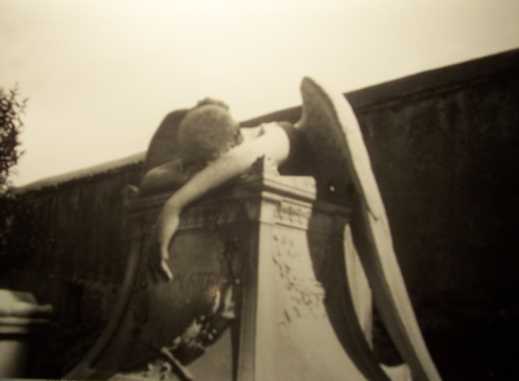
In 1999 I spent a semester studying in Rome. Just outside the old Roman walls, there is a Protestant cemetary where a great many famous Englishmen are buried. I wandered into that cemetary one perfectly overcast afternoon and spent time talking with God about life. I needed a break from the hustle of emotions that is Rome. Quite suprisingly, that cemetary was one of the most peaceful places I've ever wandered. The tombstones were works of majestic art. While I was there, I spent a lot of time lingering near John Keats' grave.

Keats was 25 when he died of tubercolisis in 1821. He was a brilliant English poet and a hinging force of the Romantic Age. He was the one who wrote that famous line, "'Beauty is truth, truth beauty,' - that is all Ye know on earth, and all ye need to know".

But what fascinates me most about Keats was that he refused to have his name written on his tombstone. Instead, he insisted they write, "Here lies one whose name was writ in water."

A week ago a young man died in my town. He was my age, only 26. I didn't know him well, but my Mom did. I had actually spoken with him just hours before he died. He fell asleep that night and never woke up. I went to his wake and cried my eyes out. And in the funeral parlor I couldn't stop staring at a (not terribly artistic, but still profound) painting of Jesus escaping alive from his stony casket.

Today I found out that a young woman whom I'd once known very well committed suicide. Many years have passed since we'd seen each other, but her honest, prayerful questions are still fresh in my mind. They were excellent questions about God's sovereignty in the midst of searing pain. We wrestled with them together, but we didn't necessarily emerge with any cheap or quick answers. Her (almost awful) honesty found its way in my poetry notebooks and scribblings, as I reflected on some of our conversations. Finding them, I wonder if she knew that she could have been a Psalmist.

In the same sitting today, I found a lengthy obituary for Sister Teresa Feeley, who died at 74. Sister Teresa was the younger sister of Sister Kathleen Feeley, who had been a visiting professor my freshman year at UMBC when I took her expository writing class. In my rush of grief, I got the two sisters confused, and thought I was in the twilight zone of death. Memories of Sister Kathleen are appropriate here. She was one who taught me about old John Keats. I really got a kick out of her sharing stories from her sweet Catholic life, though they echoed in our blaringly secular classroom. As an English professor she was delicate and kind, but yet unyielding. She'd look us each in the eye as she'd slowly quote Wordsworth, standing there in her white habit, poised and grasping the lectern: "Poetry is emotion recollected in tranquility."

Our names are written on the water. All of our days are like grass, here today, and gone tomorrow. You could say that I've been considering Moses' Psalm 90 a lot lately.